
English Longbow
The legendary war bow of medieval England
The English longbow is one of history's most devastating weapons. Standing as tall as the archer, this deceptively simple self bow dominated medieval battlefields and shaped the course of European history at Crécy, Poitiers, and Agincourt.
At Academie Duello, we teach the longbow as the medieval English would have trained it—as a martial weapon requiring years of dedication to master.
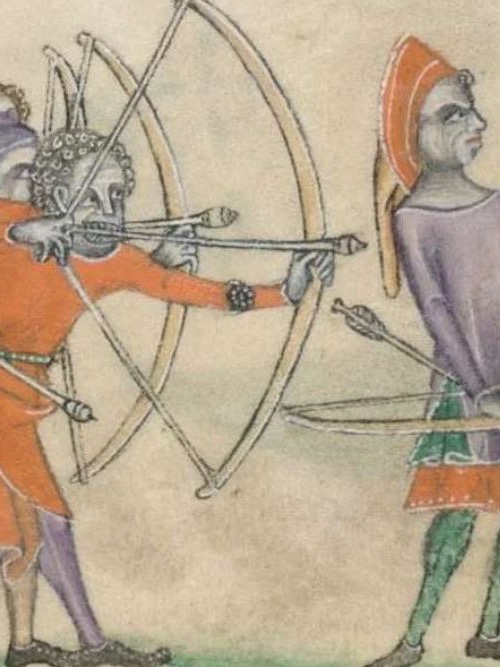
Anatomy of the Weapon
Understanding the longbow's elegant simplicity
The English longbow is a "self bow"—made from a single piece of wood, traditionally yew. The distinctive D-shaped cross-section utilizes the natural properties of the wood: the sapwood on the back resists tension while the heartwood on the belly resists compression.
A war bow typically stands between 6 and 7 feet tall, with draw weights historically ranging from 80 to over 180 pounds. Modern training bows are more accessible, typically ranging from 25 to 50 pounds.
The longbow's power comes from its length, which allows for a long draw and smooth release. Despite its simplicity, the bow demands precise form—poor technique results in poor accuracy and potential injury.
Key Characteristics
- Self Bow: Made from a single stave of wood
- Traditional Material: Yew, ash, or elm
- Height: 6-7 feet (roughly archer's height)
- Draw: Mediterranean (three-finger) technique
- Arrows: Long, heavy arrows for distance and penetration
Nature of the Art
The discipline of the English archer
The longbow demands total commitment. Medieval English law required practice from childhood, and skeletal remains of archers show distinctive bone adaptations from years of training. While we don't expect that level of dedication today, the longbow still rewards consistent, disciplined practice.
Form
The longbow demands precise body mechanics. Stance, draw, anchor, and release must work in harmony.
Power
The longbow's length allows for tremendous energy storage. Proper back tension is key to unlocking this power.
Patience
Progress with the longbow is measured in years. Each session builds on the last, slowly refining technique.
History
The weapon that shaped medieval warfare
The English longbow rose to prominence in the 13th century and reached its zenith during the Hundred Years' War. At Crécy (1346), Poitiers (1356), and Agincourt (1415), English longbowmen devastated French cavalry and infantry, demonstrating the bow's tactical superiority.
The bow's effectiveness led to the Assize of Arms requiring English men to practice archery regularly. By law, villages maintained archery butts and men were expected to train each Sunday. This created a population of skilled archers that formed the backbone of English military power.
The longbow's decline came not from obsolescence but from the difficulty of training sufficient archers. Firearms required less training, and by the late 16th century, the musket had largely replaced the bow on European battlefields.
Key Battles
Battle of Crécy
August 26, 1346
English longbowmen decimated French cavalry charges, changing medieval warfare.
Battle of Poitiers
September 19, 1356
Longbowmen helped capture the French king himself.
Battle of Agincourt
October 25, 1415
Outnumbered English archers achieved a legendary victory.
Begin Your Longbow Journey
Our archery program introduces you to the longbow alongside other traditional bow types. Start with our beginner course.