George R.R. Martin got much of his inspiration from actual events, battles, customs, and places from medieval European history. From the War of the Roses to incestuous royal marriages, from the Jacobite Wars in Scotland to Roman soldiers on Hadrian’s Wall, the parallels between our world and Westeros are striking.
Guest Right and the Law of Hospitality
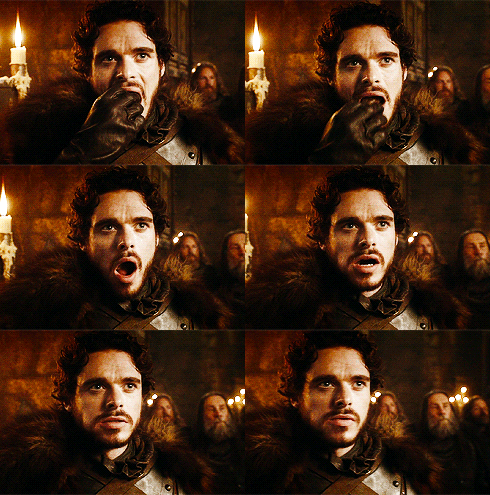
In Westeros, guest right is sacred - once bread and salt are shared, host and guest are bound by ancient custom to do each other no harm. This mirrors real historical practices.
The Greek and Roman concept of hospitium required hosts to provide protection to guests under divine law. Celtic Law similarly demanded that hosts offer refuge, food, shelter, and protection to those they welcomed. Slavic cultures offered bread and salt to honored guests as a symbol of this bond.
Breaking this sacred trust was considered among the worst possible crimes.
The Red Wedding
The most infamous scene in Game of Thrones draws directly from Scottish history - specifically the Black Douglas Dinner of 1440.
When young King James II of Scotland invited William, the 6th Earl of Douglas, to dine at Edinburgh Castle, the earl came believing in the promise of safe conduct. Instead, James II had him and his chiefs seized at the table and executed.
History repeated itself twelve years later when James II, having apparently learned nothing about the honor of his word, stabbed the 8th Earl of Douglas during yet another dinner under false promises of safety.
Like the Starks fighting for Northern independence, the Douglases had fought alongside William Wallace for Scottish freedom from English rule.
The Wall and Hadrian’s Wall
The massive ice wall separating the Seven Kingdoms from the Wildlings draws inspiration from the very real Roman structure built in 118 AD.
Hadrian’s Wall stretched 75 miles across Britain, marking the northern boundary of the Roman Empire. Like the Night’s Watch, Roman soldiers assigned to this remote frontier considered it an undesirable posting - cold, isolated, and constantly threatened by “barbarians” from beyond.
Incestuous Royal Marriages
The Targaryens’ brother-sister marriages seem shocking, but history provides numerous examples.
Egyptian rulers routinely married their siblings - Cleopatra married two of her brothers. Roman Emperor Caligula was infamous for his relationships with his sisters. The Habsburg dynasty’s extensive intermarriage led to genetic disorders that culminated in Spain’s King Charles II, who was so physically deformed he could barely function.
The War of the Roses (1455-1485)
Martin has acknowledged drawing heavily from England’s War of the Roses. The wealthy Lannisters mirror the Lancasters; the honorable Starks of the North parallel the Yorks.
The mysterious “deaths” of Bran and Rickon Stark at Theon’s hands echo the historical mystery of the Two Princes in the Tower - Edward V and his brother Richard, who may or may not have been murdered, and who may or may not have secretly escaped.
Robert Baratheon’s death in a drunken boar-hunting accident precisely mirrors how Robert de Vere, the 9th Earl of Oxford and favorite of King Richard II, met his end.
History, it turns out, is stranger and more dramatic than fiction could ever be. Martin simply had the wisdom to recognize good source material when he found it.

About the Author
Kimberleigh Roseblade
Guest Writer
Kimberleigh is an active martial artist, instructor, and writer based in Toronto, Canada. She studies and teaches with the Association of European Medieval Martial Arts (AEMMA).