At Academie Duello, we teach unarmed combat, dagger, longsword, sidesword, rapier, and polearms within a cohesive framework. Rather than treating these as isolated disciplines, students progress through weapons that share common terminology and mechanical, tactical, and strategic principles.
This approach allows each weapon to function as a teaching tool, illuminating universal combat concepts applicable across all disciplines. The rapier holds a special place in this system.
The Rapier: Master of Geometry
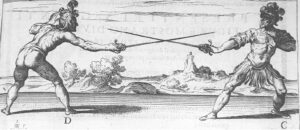
The rapier’s defining characteristic is its threatening point. From the moment an engagement begins, the rapier demands that you maintain extension toward your opponent. This constant threat forces both fencers into what the Italians called gioco stretto - “narrow play” - an intimate form of weapon engagement that demands superior positioning and leverage.
Success in this environment requires small movements and refined tactile sensitivity. You develop this through constant blade contact, learning to read your opponent’s intentions through pressure and angle rather than visual cues alone.
Body Position Optimization
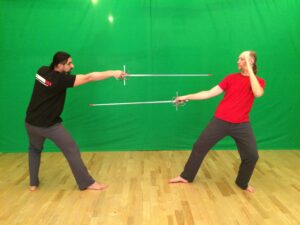
Rapier fencing requires strict structural alignment. You learn to reduce your target exposure, minimize the defensive movement required from your sword, and maximize your explosive power - all simultaneously.
Rapier fencers develop an acute awareness that life or death can result from a 2-inch change in sword position. This precision carries over to every other weapon in the system.
Tempo and Theory
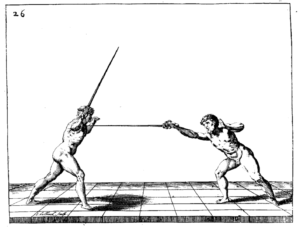
The rapier demands heightened awareness of temporal opportunities:
- Primo tempo: The moment of your opponent’s approach
- Mezzo tempo: The withdrawal of their weapon
- Contro-tempo: The controlled counterattack
Traditional Italian sources provide precise terminology for these timing and distance concepts. Learning the rapier means learning a language for describing what happens in combat.
Application to Other Weapons
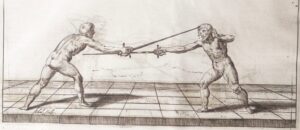
These geometric, temporal, and tactile principles apply universally. When weapons contact during attacks and parries with longswords or sideswords, practitioners encounter identical gioco stretto situations that they’ve already mastered with the rapier.
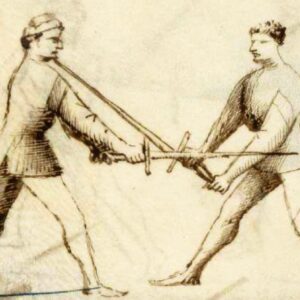
Point presentation - threatening your opponent with your weapon’s tip - appears consistently across cutting swords, staffs, and spears. The rapier, being the purest expression of point-centered fighting, provides invaluable preparation for all these weapons.
Why Study the Rapier?
The rapier develops:
- Sensitivity: The ability to feel and respond to your opponent’s pressure
- Precision: Small, efficient movements that accomplish more with less
- Timing: Understanding when to act and when to wait
- Distance: Awareness of the ranges at which different actions become possible
These skills make you better with every weapon you pick up. That’s why the rapier remains a cornerstone of our integrated martial arts curriculum.

About the Author
Devon Boorman
Founder & Director
Devon founded Academie Duello in 2004 and holds the rank of Maestro d'Armi. He has dedicated over two decades to researching and teaching Historical European Martial Arts.