Solo martial arts practice offers personal fulfillment without the responsibility of training partners or students. During these sessions, practitioners can concentrate entirely on their own body mechanics, movement flow, and individual training objectives.
A key advantage involves independence: you can train whenever your schedule permits without coordinating with others.
Training Motivations
Solo practice encompasses several distinct approaches:
- Physical Fitness - Building the conditioning base for martial work
- Motor Programming - Developing movement patterns until they become automatic
- Power Training - Building explosive capacity
- Efficiency Training - Eliminating wasted motion
- Flow & Sequencing - Connecting techniques smoothly
- Relaxation - Moving without tension
- Enjoying Movement - Finding joy in the practice itself
Physical Fitness
Martial artists often incorporate cross-training activities like running, rope skipping, cycling, or swimming to develop cardiovascular endurance. As Persian martial arts researcher Manouchehr Khorasani notes, “Physical conditioning is the first martial technique.”
Effective solo fitness work emphasizes:
- Cardiovascular health for sustained activity
- Joint and connective tissue development for injury prevention
- Core and structural strength for power generation
Don’t neglect the boring fundamentals. They make everything else possible.
Motor Programming, Power, and Efficiency
Strikes, footwork, blade control, and weapon maneuvering benefit significantly from solo practice using targets and training equipment. Repetition builds neural pathways that make techniques automatic.
However, practitioners should recognize that opponent-dependent techniques require regular partnered practice to remain effective. You can perfect a thrust against a target, but only a partner teaches you timing against a moving opponent.
Flow & Sequencing
Connecting techniques smoothly mirrors learning musical chords or language phrases. Individual words aren’t enough - you need to speak in sentences.
Emphasis should prioritize rhythm and smoothness before speed, ensuring each technique achieves full effectiveness before transitioning to the next. A jerky, interrupted sequence done quickly is worse than a smooth sequence done slowly.
Relaxation and Enjoyment
Solo practice provides non-judgmental movement exploration. There’s no one to compare yourself to, no one to impress.
Many practitioners incorporate music and themed routines to maintain mental clarity while experiencing the fulfillment of active engagement. Put on something that matches the mood you want - energetic for power work, meditative for flow training.
The beautiful thing about solitary practice is that it’s entirely yours. Shape it to serve your needs.
About the Author
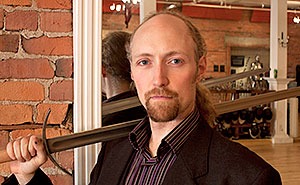
Devon Boorman
Founder & Director
Devon founded Academie Duello in 2004 and holds the rank of Maestro d'Armi. He has dedicated over two decades to researching and teaching Historical European Martial Arts.